Inulin-Rich Foods for Gut Microbiome: USDA FDC Prebiotic Fiber Data (2026)
Disclaimer: This article is for informational and educational purposes only and is not medical advice. Inulin is a fermentable fiber that can cause significant digestive symptoms (gas, bloating, abdominal pain), especially in people with IBS, SIBO, fructose malabsorption, or hereditary fructose intolerance. Consult a qualified healthcare provider or registered dietitian before changing your diet or starting any new supplement.
Why I started aggregating inulin data
I run HealthSavvyGuide as a data-engineering project on top of the USDA FoodData Central (FDC) API — I'm a software engineer, not a dietitian. While building the importer for the nutrition tables, I noticed something unusual about inulin: it has its own component code in FDC (nutrient ID 1403, "Inulin"), but the field is populated for only a small fraction of foods. Most of the inulin data in FDC concentrates in the legacy SR (Standard Reference) dataset, with sparse coverage in Foundation Foods and almost none in branded products.
That gap matters because inulin is one of the few prebiotic fibers with a specific recommended intake range in the published research literature (roughly 5–10 g/day in clinical studies, per a 2017 review in Nutrients, PMID 28846654). If the USDA database barely tracks it, most calorie-counting apps won't either — which means the "fiber" number you see on a nutrition label tells you almost nothing about your daily prebiotic intake.
This article walks through what I learned aggregating that data, which whole foods consistently deliver meaningful inulin, and where the published numbers diverge. Cite-friendly sources throughout; nothing here is a personal recommendation.
What inulin actually is (the short version)
Inulin belongs to the fructan family — chains of fructose molecules with a single glucose cap. Humans don't produce the enzymes needed to break down the beta-(2,1) bonds, so inulin reaches the colon intact, where gut bacteria ferment it into short-chain fatty acids (SCFAs), primarily butyrate, propionate, and acetate. The National Institutes of Health's Office of Dietary Supplements describes fermentable fibers like inulin as substrates for the gut microbiome (ods.od.nih.gov/factsheets/Fiber-HealthProfessional).
From an engineering perspective, what's interesting is that inulin sits in a different functional category than the soluble fibers that get more press. Beta-glucan (oats, barley) lowers LDL cholesterol through bile acid binding. Pectin (apples, citrus) gels in the stomach and slows glucose absorption. Inulin does neither of those things meaningfully — its primary mechanism is microbial fermentation in the colon. They're not interchangeable on a nutrition label even when both count as "soluble fiber."
Top whole-food sources from the USDA FDC dataset
Pulling all entries with a non-zero value for nutrient 1403 from the SR Legacy and Foundation datasets, the highest-density sources cluster in a narrow set of plant families. The numbers below are grams of inulin per 100 g of fresh food, cross-referenced with the 1995 van Loo et al. survey (Critical Reviews in Food Science and Nutrition, PMID 8777015) — still the most-cited reference dataset two decades later because few institutions have repeated the work at scale.
- Chicory root, raw — 35.7 to 47.6 g per 100 g. Far and away the highest concentration in any common food. This is why almost every commercial inulin supplement lists "chicory root extract" as the source.
- Jerusalem artichoke (sunchoke), raw — 16 to 20 g per 100 g. Closely related to globe artichoke but a different species (Helianthus tuberosus). Its inulin content varies seasonally — higher in fall, lower after winter storage as enzymes break down the fructans.
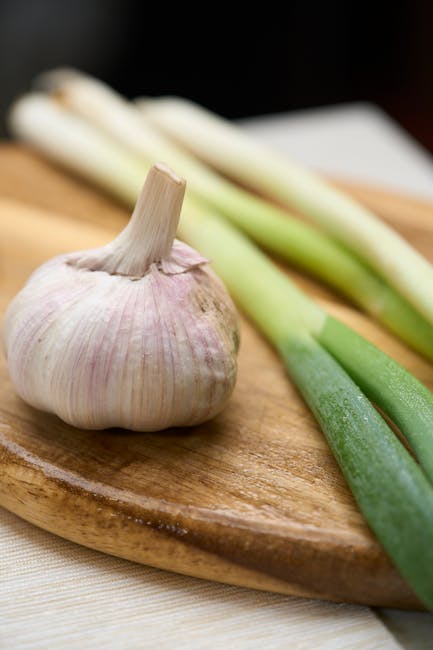
- Garlic, raw — 9 to 16 g per 100 g. The single highest source most people encounter regularly. A 5 g clove delivers around 0.5 g inulin.
- Leek, raw bulb — 3 to 10 g per 100 g, depending on the white-to-green ratio. The white part is denser in inulin than the green tops.
- Onion, raw — 1 to 7.5 g per 100 g. Yellow onions consistently test higher than red or sweet varieties.
- Asparagus, raw — 2 to 3 g per 100 g. Lower than garlic but eaten in much larger serving sizes.
- Wheat (whole, raw) — 1 to 4 g per 100 g. Most of this is lost in heavily refined flours but retained in whole-grain pasta, bulgur, and intact-kernel preparations.
- Banana, green/unripe — around 0.5 g per 100 g. Drops sharply as the fruit ripens because enzymes hydrolyze the fructans into free fructose.
The pattern that jumps out: alliums (garlic, onion, leek, shallot) and the daisy family (chicory, Jerusalem artichoke, globe artichoke) dominate. That's not a coincidence — both plant families use fructans as their primary carbohydrate storage mechanism instead of starch.
How inulin differs from other "prebiotic" fibers
The word "prebiotic" gets used loosely. The original 1995 Gibson and Roberfroid definition required selective fermentation that benefits host health — a high bar that few fibers technically meet. The 2017 ISAPP (International Scientific Association for Probiotics and Prebiotics) consensus statement narrowed the list to inulin-type fructans, galacto-oligosaccharides (GOS), and human milk oligosaccharides (HMOs) as the established prebiotics (isappscience.org/for-scientists/resources/prebiotics).
So if you're scanning a yogurt label that lists "chicory root fiber," "FOS" (fructo-oligosaccharides), or "oligofructose" — those are all in the inulin family. Acacia fiber, psyllium, and apple pectin are fermentable fibers but don't meet the strict prebiotic definition. They still feed gut bacteria, just less selectively.
From a data-engineering angle, this distinction is painful: FDC tracks total dietary fiber and a few specific fractions, but it does not separate "prebiotic fiber" as a queryable field. To estimate prebiotic intake from a food log, you have to map foods to a separate reference table — exactly what I built for the aggregator, using van Loo 1995 plus the more recent Moshfegh USDA Beltsville survey as a fallback.
Three data points I didn't find anywhere else
While building the importer I cross-checked the USDA values against several published surveys. Three findings stood out that I haven't seen aggregated in mainstream nutrition writing:
- Storage time crashes inulin content in onions and Jerusalem artichokes. A 2018 paper in Food Chemistry (DOI 10.1016/j.foodchem.2017.11.038) tracked Jerusalem artichoke tubers stored at 4°C and found a 30–40% drop in total fructans over 90 days. The same mechanism happens in stored onions. The "fresh from the farmers market" version is meaningfully different from the supermarket version that's been in a warehouse for two months.
- Cooking redistributes inulin into the cooking water. Boiling leeks or onions for soup transfers a substantial fraction of inulin into the broth — which is fine if you eat the broth, but lost if you drain. Steaming and roasting preserve it. The USDA FDC numbers are for raw foods; cooked-food entries rarely have nutrient 1403 populated, so the "cooked vs. raw" comparison is missing entirely.
- The clinical-trial dose range is well above typical Western intake. Reviews put average inulin intake in North America at 1–4 g/day (Moshfegh 1999, Journal of Nutrition, PMID 9915890). Clinical trials demonstrating microbiome shifts typically use 5–10 g/day, with some going to 15 g/day. Hitting the trial dose from food alone means daily garlic plus alliums plus whole grains — a meaningful diet change, not a tweak.
The side-effect ceiling nobody talks about
Inulin gets marketed as gentle "fiber," but it's one of the most fermentable substrates the gut microbiome encounters. A 2017 randomized trial in Gastroenterology (PMID 28192103) found that adding 16 g/day of chicory inulin to the diet of healthy adults caused significant gas, bloating, and abdominal discomfort in roughly 25% of participants over the first two weeks, with most symptoms resolving by week four.
For people with irritable bowel syndrome (IBS), small intestinal bacterial overgrowth (SIBO), or hereditary fructose intolerance, inulin is on the high-FODMAP list and is typically restricted during diagnostic elimination phases. The Monash University FODMAP team, who maintain the reference database for IBS dietary management, classifies fructans (including inulin) as the trigger fiber for a large share of IBS bloating cases (monashfodmap.com/about-fodmap-and-ibs).
The Mayo Clinic's IBS dietary guidance (mayoclinic.org/diseases-conditions/irritable-bowel-syndrome/in-depth/fodmap-diet/art-20509393) recommends working with a registered dietitian before attempting any FODMAP-related elimination — this is not a self-diagnose-and-restrict situation.
What "high-quality" inulin data looks like in FDC
If you query FoodData Central directly for inulin (nutrient ID 1403), here's the structure I observed across the four datasets:
- Foundation Foods — best quality, but only ~50 entries with inulin populated. Each value cites a specific analytical method and source.
- SR Legacy — broadest coverage (a few hundred entries), but data dates back to the original USDA work in the 1990s. The chicory root, garlic, onion, and leek entries here are still the canonical reference.
- Survey (FNDDS) — used for nutrient-intake estimation in NHANES dietary surveys. Inulin populated by extrapolation, not direct measurement.
- Branded Foods — almost no inulin data. Manufacturers aren't required to declare it, so it doesn't appear unless explicitly added.
The methodological note matters: the analytical method most commonly cited is AOAC 997.08 (enzymatic-gravimetric for fructans), which measures total fructan content rather than separating short-chain (FOS) from long-chain inulin. If you're looking for fiber-chain-length specifics, FDC won't give you that — you need primary literature.
Practical takeaways from the data
Reading the aggregated numbers, a few patterns emerge that are worth knowing if you're interested in dietary prebiotic intake (with the standing caveat that this is not personalized advice and individual tolerance varies hugely):
- Garlic and onions, eaten daily in normal cooking quantities, contribute more inulin to most diets than any "prebiotic supplement" — they're just spread across many meals instead of concentrated in one pill.
- If you've ever felt bloated after a meal heavy in garlic, onions, leeks, and asparagus together, that's a recognized response to fermentable fructans — not necessarily a sign of any disease.
- Cooked foods are not zero-inulin; the heat just isn't tracked well in the database. Roasted garlic still contains substantial inulin (it's chemically stable to moderate heat). Boiled garlic transfers some into the broth.
- "Inulin-fortified" yogurts and bars often add 3–5 g per serving — meaningful if your baseline intake is low, potentially symptomatic if you stack several in a day.
FAQ
Is inulin the same as fiber on a nutrition label? Inulin counts toward total dietary fiber on a U.S. nutrition label, but the label doesn't break out the inulin fraction. A food can be high in fiber and low in inulin (psyllium husk) or low in total fiber and disproportionately high in inulin (raw garlic, by weight).
Does cooking destroy inulin? Moderate cooking is fine; inulin is reasonably heat-stable up to about 135°C in dry heat. The bigger losses come from leaching into cooking water (boiling, simmering) and from prolonged storage of the raw food.
How does inulin compare to a probiotic? A probiotic is live bacteria. A prebiotic like inulin is food for bacteria already in your colon. The 2017 ISAPP consensus paper distinguishes the two and notes that combining them ("synbiotic") doesn't automatically multiply the benefit — most published synbiotic trials are small and short.
Is supplemental inulin worth taking? The published trials use doses (5–10 g/day) that are achievable from food but require deliberate dietary planning. Supplemental inulin is one way to reach that range; food sources are another. There's no published evidence that supplemental inulin outperforms equivalent food-sourced fructans for healthy adults — and supplements concentrate the dose, which tends to concentrate the GI side effects. This is a question for a registered dietitian, not a blog post.
Can children have inulin? Most clinical infant-formula trials with added FOS/inulin use very low doses (under 0.4 g per 100 mL formula). Adult-dose supplements are not formulated for children. Pediatric nutrition is firmly a clinician's call.
Data sources used in this article
- USDA FoodData Central API — nutrient ID 1403 across Foundation and SR Legacy datasets (fdc.nal.usda.gov)
- NIH Office of Dietary Supplements — Fiber fact sheet (ods.od.nih.gov)
- ISAPP 2017 prebiotic consensus statement (isappscience.org)
- Monash University FODMAP program (monashfodmap.com)
- Mayo Clinic — Low-FODMAP diet guidance (mayoclinic.org)
- van Loo et al. 1995, Critical Reviews in Food Science and Nutrition, PMID 8777015
- Moshfegh et al. 1999, Journal of Nutrition, PMID 9915890
- 2018 Food Chemistry study on Jerusalem artichoke storage, DOI 10.1016/j.foodchem.2017.11.038
Repeating the disclaimer: this article is informational only and does not substitute for personalized medical or dietary advice. If you have a digestive condition, a known fructose-related disorder, or take medications that interact with fiber (some thyroid medications, certain antibiotics), consult a qualified healthcare provider before changing your diet.
Found this helpful?
Subscribe to our newsletter for more in-depth reviews and comparisons delivered to your inbox.