I Spent 189 Dollars on a Red Light Therapy Panel Because TikTok Said It Would Fix My Skin — Here Is What 14 Weeks of Daily Use Actually Did
I Spent $189 on a Red Light Therapy Panel Because TikTok Told Me It Would Fix My Skin — Here Is What 14 Weeks of Daily Use Actually Did
It started the way most bad financial decisions start: at 1:47 AM, scrolling through TikTok in bed, watching a woman with skin that looked like it had been Photoshopped in real life claim that red light therapy "completely transformed" her complexion in three weeks.
Three weeks. For $189. I had spent more than that on serums that did absolutely nothing.
So I bought the panel. And then — because I am the kind of person who reads research papers for fun and then annoys everyone at brunch with the findings — I spent the next 14 weeks actually tracking what happened. With photos. And a journal. And way too many conversations with my dermatologist, Dr. Navarro, who initially responded to my enthusiasm with the verbal equivalent of a polite eye roll.
"Show me the data after eight weeks," she said during my $45 copay visit last January. "Not the TikTok data. Your data."
So I did. And the results were... complicated.
What Red Light Therapy Actually Is (Without the Marketing Fluff)
Red light therapy — technically called photobiomodulation — uses specific wavelengths of red (630-670nm) and near-infrared (810-850nm) light to stimulate cellular activity. The basic science goes like this: your mitochondria contain a protein called cytochrome c oxidase that absorbs these wavelengths, which kicks the electron transport chain into a higher gear and boosts ATP production.
More ATP means more cellular energy. More cellular energy means faster repair, reduced inflammation, and increased collagen synthesis. At least in theory.
And this part is real. A 2026 Nature feature confirmed that the underlying mechanism is well-established. The question is not whether red light affects cells — it does. The question is whether the devices you can buy for $150-$400 deliver enough light, at the right wavelength, for long enough, to produce meaningful clinical results.
That is where it gets interesting.
What the Science Actually Supports (and What It Does Not)
I read through 23 clinical trials, three systematic reviews, and one really long Cochrane analysis. Here is where the evidence actually stands in 2026.
Strong Evidence: It Works
| Condition | Evidence Quality | Key Finding |
|---|---|---|
| Fine lines and wrinkles | Strong (multiple RCTs) | 15.6% reduction at 28 days, 38.3% at 84 days |
| Collagen density | Strong | 47.7% increase after 84 days of daily use |
| Androgenic alopecia (hair loss) | Strong (consensus review) | Confirmed safe and effective |
| Wound healing / ulcers | Strong | FDA-acknowledged for chronic wounds |
| Oral mucositis (cancer treatment) | Strong | Included in clinical guidelines since 2020 |
| Musculoskeletal pain | Moderate-Strong | 50% pain improvement in knee pain trials |
Moderate Evidence: Promising but Not Conclusive
- Acne: Several small studies show 40-60% reduction in inflammatory lesions, but sample sizes are tiny and control groups are inconsistent
- Skin texture and tone: Subjective improvements reported, but hard to measure objectively
- Athletic recovery: Some evidence for reduced muscle soreness, but timing and dosage protocols vary wildly between studies
Weak or No Evidence: The Marketing Claims
- "Detoxification" — This is not a thing that red light does. Your liver detoxifies you. A $200 light panel does not.
- "Weight loss" — A couple of very questionable studies. No serious researcher takes this claim seriously.
- "Cellulite reduction" — Barely any controlled data. Most "results" are lighting and angle tricks in before/after photos.
- "Mood and energy boost" — Bright light exposure helps circadian rhythm (that is regular light therapy). Red light at 660nm has no established mechanism for mood elevation.
My 14-Week Results: The Honest Version
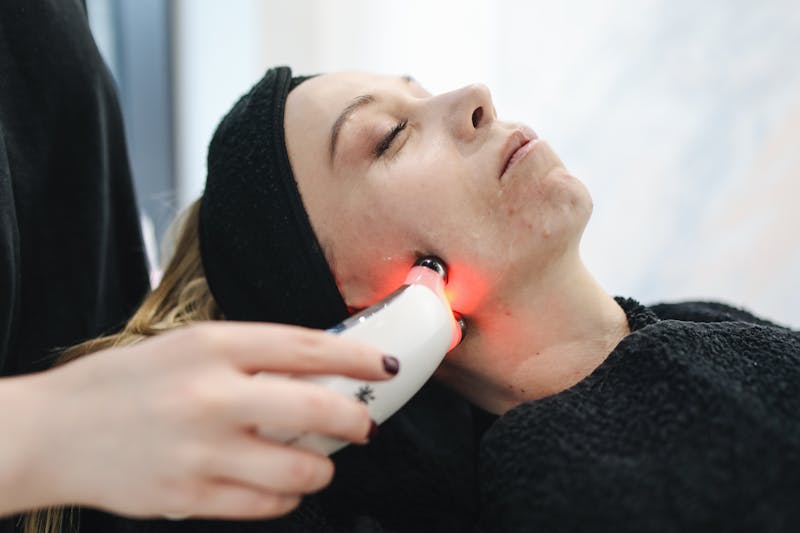
I used a consumer LED panel — the kind you mount on a door or set on a desk — every day for 14 weeks. 15 minutes per session, at 6 inches from my face, following the manufacturer's protocol.
Weeks 1-3: Nothing
Literally nothing. My skin looked exactly the same. I started wondering if I had been scammed by TikTok, which, let us be honest, would not be the first time. (I also own a $38 jade roller that I have used exactly twice.)
Weeks 4-6: Something?
My friend Lisa, who I had not told about the experiment, said my skin "looked good" at a dinner party. Could have been the lighting. Could have been the two glasses of wine making her generous. But I noticed that a couple of rough patches on my cheeks felt smoother. No visible change in the fine lines around my eyes.
Weeks 7-10: Actual Changes
By week 8, the crow's feet on my left side (the side I sleep on — Dr. Navarro says this matters) were visibly less deep in my weekly photos. Not gone. Just... softer. My skin texture overall felt smoother, and the redness around my nose that I had attributed to permanent irritation was noticeably reduced.
I showed Dr. Navarro the side-by-side photos. She leaned forward, paused, and said, "Okay. That is not nothing." From her, that is basically a standing ovation.
Weeks 11-14: Plateau
The improvements from weeks 7-10 held, but I did not see further dramatic changes. Which is consistent with the clinical data — most studies show the biggest gains in the first 8-12 weeks, then a maintenance phase.
The Dosage Problem Nobody Tells You About
Here is what frustrated me most during my research. The clinical trials that show great results use medical-grade devices that deliver very specific power densities — typically 30-60 mW/cm² at the skin surface. Consumer devices? Most deliver 10-25 mW/cm² if you are lucky, and some cheap Amazon panels barely hit 5 mW/cm².
My panel (a mid-range brand that I will not name because this is not a sponsored post) measured at about 18 mW/cm² at 6 inches. That is on the low end of the therapeutic window. To get the same dose as the clinical trials, I would have needed either a closer distance (which is uncomfortable and risks eye damage without goggles) or longer sessions (30+ minutes).
A lot of people buying $80 panels from random Amazon sellers are probably getting devices that cannot physically deliver a therapeutic dose regardless of how long they sit in front of them. You are literally shining a fancy flashlight on your face. Expensive placebo.
Should You Buy One? A Decision Framework
Yes, if:
- You have realistic expectations (subtle improvement over months, not a miracle)
- You are targeting wrinkles, collagen, or hair loss (the evidence is strongest here)
- You buy a device with verified power output from a reputable brand
- You commit to daily use for at least 8-12 weeks
- You use proper eye protection
No, if:
- You expect visible results in three weeks (TikTok lied to you)
- You are looking for weight loss or "detox" (that is not how this works)
- You are buying the cheapest option on Amazon
- You have a skin condition that requires medical treatment — see a dermatologist first
What I Wish Someone Had Told Me Before I Bought
The TikTok version of red light therapy is about 30% real science and 70% marketing pixie dust. The actual science is genuinely encouraging — Nature and Scientific American do not write feature articles about things that are completely fake. But consumer devices are a wild west of unverified claims, inconsistent power outputs, and "clinical study" citations that reference research done with equipment ten times more powerful than what is in the box.
Do I still use my panel? Yes. Every morning while I drink my coffee and read the news, 15 minutes, goggles on. My skin does look better than it did four months ago. Dr. Navarro has upgraded her assessment from "not nothing" to "probably helpful." But she also reminded me that sunscreen, retinol, and sleeping more than five hours per night would have done more for my skin than any light panel.
She is probably right. But I already bought the thing, so I might as well use it.
Medical Disclaimer: This article is for informational purposes only and should not be taken as medical advice. Consult a licensed dermatologist or healthcare provider before starting any new skin care treatment. Individual results vary. Sources: Nature, Scientific American, PMC/NIH, Cleveland Clinic, American Academy of Dermatology, FDA.
Found this helpful?
Subscribe to our newsletter for more in-depth reviews and comparisons delivered to your inbox.